
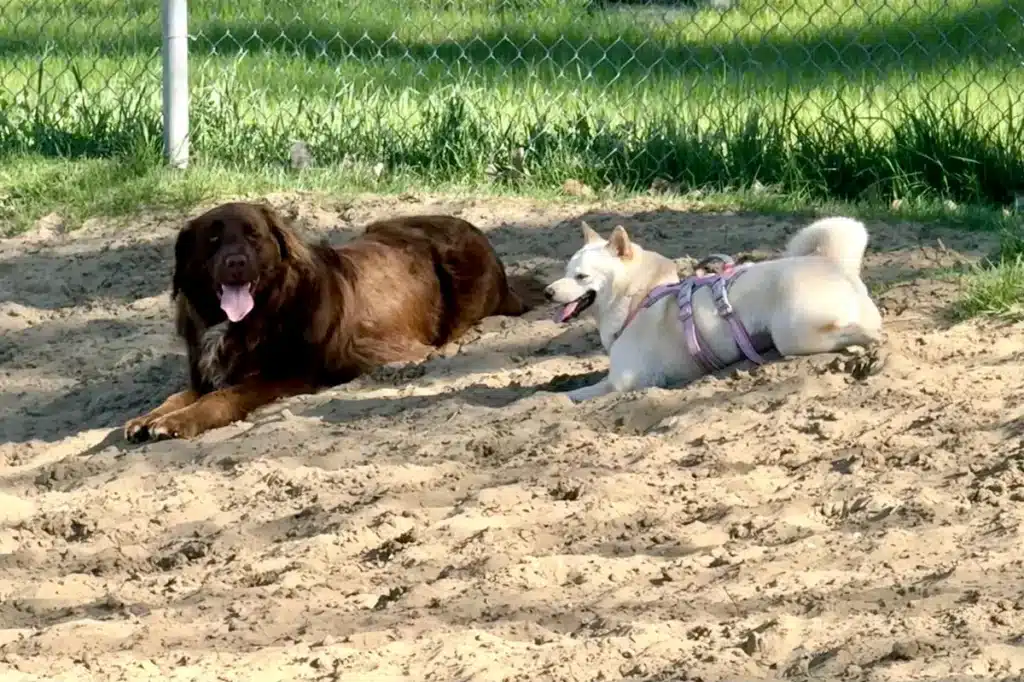
Watching a white shiba inu socializing at the dog park is one thing; watching my white Shiba, Émi, do it is another entirely. I always find myself holding my breath for a second, not because she is fragile, but because she is so unmistakably Shiba about everything. She likes to decide for herself. She likes to observe first. And in this sunny little dog park moment, with warm sand under her paws, bright green grass behind the chain-link fence, and a much larger brown dog already stretched out and panting nearby, she handled the whole interaction in the most Émi way possible: calm, curious, lightly dramatic, and completely on her own terms.
What I loved most here was how natural it all felt. There was no refusal, no stubborn little statue routine, no “absolutely not” energy. This was simply Émi being social in a very honest dog way: sniffing, pausing, resting, getting startled, resetting her distance, then happily joining a chase before settling down again beside her new companion.
Quick Summary & Key Takeaways
- Émi calmly approached a large brown dog that was already lying in the sandy area and sniffed near its head.
- She chose to lie down close to the bigger dog, which showed comfort and social interest.
- A sudden bark made her pop up and move away briefly, but she returned and lay down again at a slightly safer distance.
- Later, when both dogs were standing, the bigger dog initiated a playful chase and Émi eagerly joined in.
- After running, both dogs returned to resting behavior, which is an excellent sign of balanced, comfortable interaction.
- This was a great example of shiba inu body language with other dogs: observe, test the space, play, regulate, and re-engage.
- For anyone thinking about introducing your shiba inu to big dogs, this clip shows why respectful pauses and voluntary re-approaches matter so much.
White Shiba Inu Socializing at the Dog Park: The First Approach
The moment begins so peacefully that it almost feels suspended in the heat. The sandy patch is pale and sunlit, the grass behind it looks almost vivid, and the chain-link fence gives the whole space that familiar dog park backdrop of safety without taking away the open-air feeling. The larger brown dog is already there, lying down and panting, loose and relaxed. Nothing about that posture looks pushy or tense.
Émi, in her pink harness, approaches without any fuss. She does not rush in wildly. She does not hover nervously at a distance. She calmly sniffs around the brown dog’s head, gathering information the way dogs do best. Then, in a detail I found especially telling, she decides to lie down too. Not across the park. Not behind me. Right there, close to him.
For me, that is one of the clearest signs of comfort. When Émi chooses proximity on her own, I pay attention. A Shiba does not usually hand out closeness for free. If she settles near another dog, especially a much bigger one, I know she is feeling safe enough to share space without pressure.
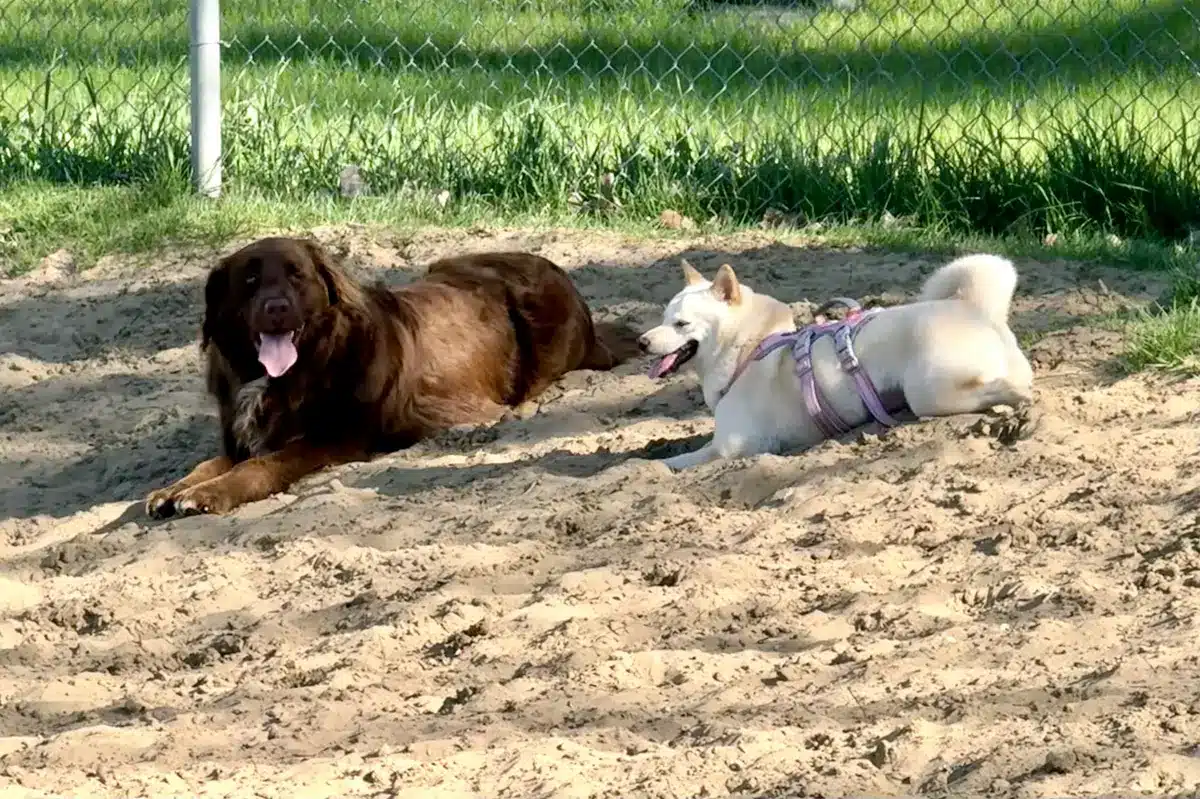

In the image, both of them look wonderfully at ease. The big brown dog is stretched out with his tongue out, content in the warmth, while Émi lies beside him with her head turned in his direction. Her curled tail is perched over her back, her pink harness catches the sun, and the whole scene has that quiet dog-park magic I never get tired of: two dogs saying a lot without making a big show of it.
That is one of the biggest things I have learned from watching shiba inu body language with other dogs. Silence can be a very good sign. Resting together can say more than bouncing ever could.

The Bark, the Startle, and Émi’s Very Shiba Reset
Then comes the tiny burst of drama. A sudden bark breaks the calm, and Émi immediately pops up and moves a short distance away. I had to smile at that because it is such a fair, sensible response. She is not falling apart. She is not spiraling into panic. She is simply saying, in classic Émi fashion, “Excuse me, I did not agree to that level of volume.”
What happens next matters even more than the startle itself: she returns. She lies down again, just a little farther from the brown dog than before.
That small adjustment is exactly why I find these interactions so interesting to watch. She is not rejecting the dog. She is not shutting down. She is recalibrating. She wants the company, but with a bit more room. Honestly, I admire that. There is something so self-possessed about it. If ever there were a Shiba translation for “I still like you, but let’s respect personal space,” this was it.
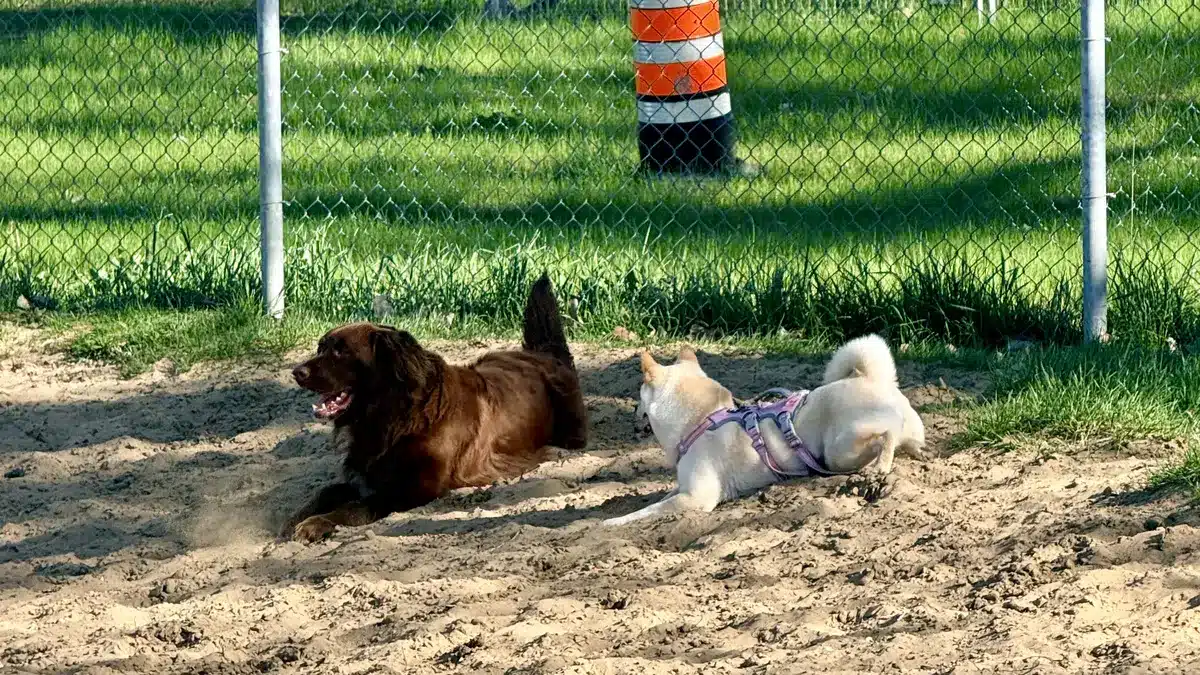

This second image captures that sandy stillness beautifully too. The brown dog is lying on its side with its mouth open, and Émi is nearby, relaxed but attentive. You can almost feel the warmth of the ground and hear the soft park sounds in the background: panting, paws shifting in sand, the little ambient noises that always surround dogs when they are deciding what comes next.
If you are learning dog park etiquette for small dogs, this is such a useful moment to study. Small dogs do not need to be forced into constant close contact just because they were doing fine one second earlier. Sometimes the healthiest interaction is exactly this: create a bit of distance, take a breath, then choose whether to come back.
When the Mood Changes from Rest to Play
Later, the scene opens up and both dogs are standing. That shift matters. Resting together is one kind of social comfort; choosing to move together is another. Émi watches the brown dog, alert and interested, and then the larger dog initiates a playful chase.
And off she goes.
Émi darts across the sandy area with that quick, light, agile movement Shibas do so well. The bigger dog follows, and the energy between them feels playful rather than overwhelming. She is not trying to flee the interaction. She is engaging with it. Her willingness to run, turn, and stay in the game tells me she is comfortable enough to be expressive.
I always love this part of dog socializing because some of the best communication happens at full speed. Dogs can test each other’s energy, pacing, and enthusiasm in a matter of seconds. Émi does not look trapped in the exchange. She looks delighted by it.
Then, just as naturally as the chase began, the brown dog lies down again. And Émi, in a tiny detail that felt very true to her personality, keeps going for one more little loop before settling near him once more. I laughed at that. It had such a “fine, I’ll stop in a second” quality to it.
Introducing Your Shiba Inu to Big Dogs: What Émi Demonstrated Perfectly
For anyone nervous about introducing your shiba inu to big dogs, this was a lovely example of what a healthy interaction can look like when nobody is being rushed. The size difference is obvious. The brown dog is much larger, heavier-looking, and more physically imposing. But good social moments are not only about size. They are about choice, pacing, and recovery.
Émi showed several things I always want to see:
She approached voluntarily. Nobody dragged her into the greeting.
She rested near the bigger dog. That is a strong sign that the presence felt manageable and safe.
She moved away when surprised. Good dogs are allowed to have boundaries.
She re-approached on her own. That says trust far more clearly than forced closeness ever could.
She accepted play. The chase only worked because she willingly joined it.
She came back down afterward. A dog who can play, then settle again, is showing lovely emotional balance.
That last point is important. Excitement alone does not tell me much. The real clue is whether a dog can return to calm. Émi did exactly that.
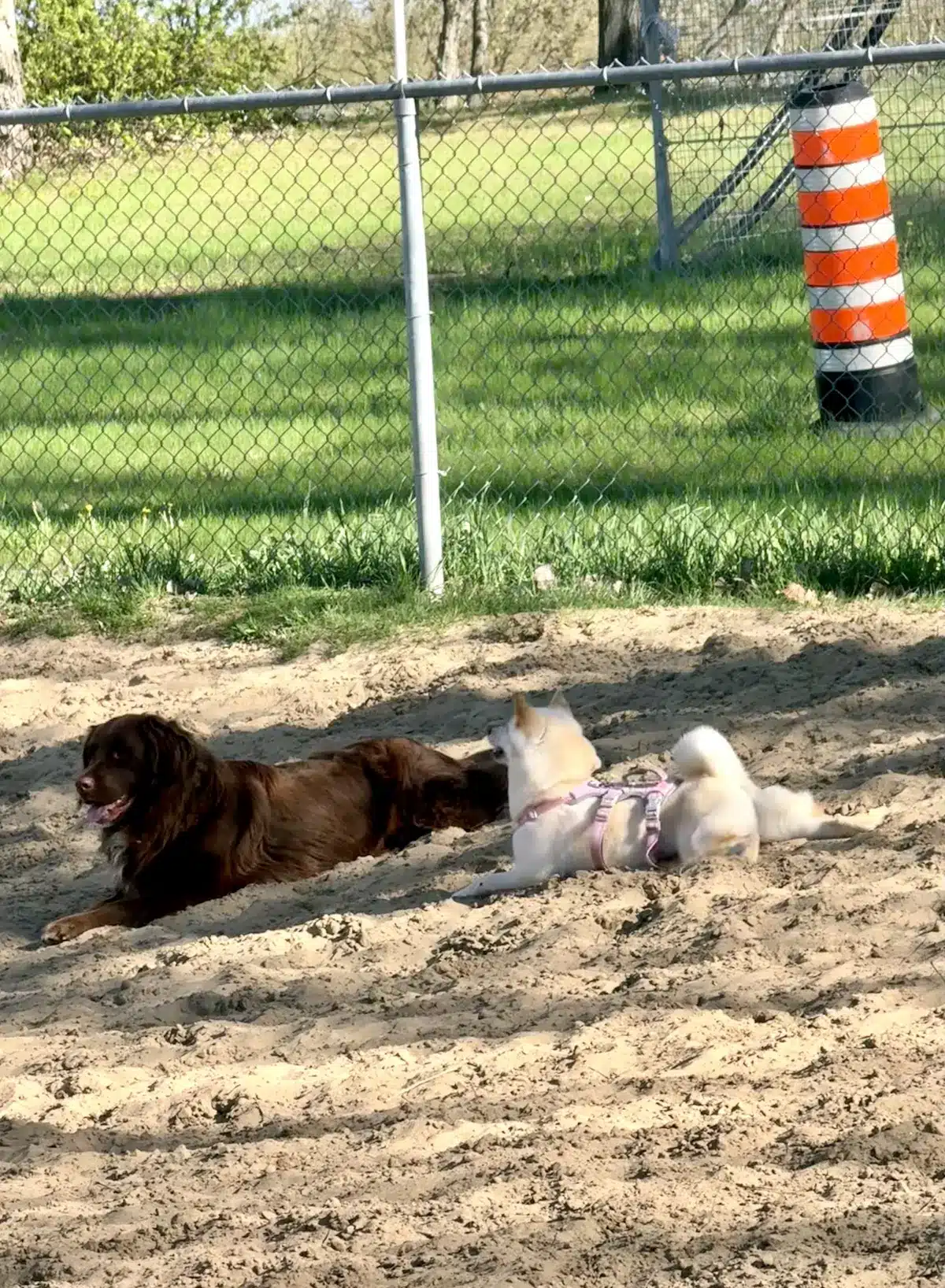

In this final image, both dogs are back in that peaceful, sandy coexistence. The grass beyond the fence looks lush in the sunlight, and the whole park has that bright summer clarity that makes every shadow crisp. Émi is lying on her belly again, pink harness visible, curled tail fluffed over her back, looking toward the bigger dog. To me, this image says everything the video says in motion: she was not merely tolerating him. She was comfortable sharing the space.
Reading Émi’s Body Language with Big Dogs
This is how I read Émi’s behavior from start to finish.
Calm sniffing near the head: social curiosity, not avoidance.
Choosing to lie down close by: real comfort and willingness to remain in the other dog’s space.
Quick reaction to the bark: a normal startle response, especially in a small dog beside a much larger one.
Returning and lying down slightly farther away: thoughtful boundary-setting, not fearfulness.
Joining the chase eagerly: playful engagement and confidence.
Running a small extra loop after the brown dog stopped: lingering excitement, but still within a playful, balanced interaction.
Settling down near him again afterward: excellent regulation and social ease.
Brief nuzzle and sniff before walking off separately: a very polite closing note to the interaction.
I think this is why I never like reducing Shibas to “stubborn” and stopping there. Yes, Émi absolutely has opinions. Yes, she can be hilariously selective about when she cooperates. But what I saw here was not stubbornness at all. It was discernment. She read the dog, read the moment, adjusted when she needed to, and stayed open to connection.
Dog Park Etiquette for Small Dogs: The Lesson I Took from This Moment
If I had to sum up the best dog park etiquette for small dogs from this exact interaction, it would be this: let the small dog have a voice in the spacing.
Émi was a wonderful reminder that successful dog socializing does not always look like nonstop wrestling or constant chasing. Sometimes it looks like lying nearby. Sometimes it looks like stepping away after a bark. Sometimes it looks like resting, watching, then joining in when the timing feels right.
I also love that the dogs did not cling to each other at the end. They briefly sniffed and nuzzled, then walked off in separate directions. That is good social behavior too. A nice meeting does not have to end in dramatic best-friend energy. Sometimes a respectful “that was pleasant” is perfect.
Why This Little Scene Stayed with Me
There is something deeply endearing about watching Émi navigate the world exactly as herself. She is independent, observant, and occasionally just a tiny bit extra about where she will place her body and how much excitement she is willing to tolerate. I say that with all the affection in the world. It is part of what makes her her.
In this sunny dog park scene